spacer

NCRR History

NOW...

Today, the North Carolina Railroad actively seeks projects that will improve passenger and freight travel as well as looking for ways to help communities reach their economic potential. Actually, that’s the same mission the railroad had when it was built. Here are some of the company’s highlights:

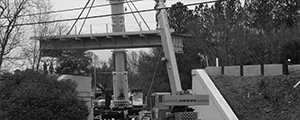
2008: The rail bridge span over Old Highway 70 in Clayton, NC was replaced, eliminating speed restrictions and improving clearance on the highway. The previous bridge, dated 1900, had been damaged by trucks striking its girders.

2007: In order to add capacity for both freight and passenger trains, NCRR added three new passing sidings and centralized traffic control to raise this segment to the standard of the Raleigh to Charlotte mainline. The project cost $20,700,000.

2006: Completed in May, this new bridge over Highway 54 in Research Triangle Park replaces the old single-track bridge that had substandard clearance and, because of its narrowness, caused a significant bottleneck on Highway 54. The new bridge is double-tracked to increase train capacity and speed. The improvements will allow traffic to flow smoothly and safely on the road below while allowing both freight and passenger trains to move along the corridor.

2003: The Neuse River Bridge in Kinston was replaced; the first bridge completed through the Capital Improvement Program. This nearly 100-year old structure developed a large crack in the east abutment after Hurricane Floyd, making it unsafe for further use. The new bridge is designed to carry the faster, heavier cars that are common on today’s freight routes.

2001: The implementation of a Corridor Improvement Program that serves as the blueprint for upgrading the railroad was put into place and the first projects, $10 million worth of improvements along the corridor between Goldsboro and Morehead City, were completed.

NCRR approves a contract with Norfolk Southern and the N.C. Department of Transportation to complete $30 million of improvements that will eliminate 20 minutes of daily passenger travel time between Raleigh and Charlotte.

A corridor upgrade between Raleigh and Selma is completed, allowing for an increase in speed on the rail from 49 mph to 59 mph.

Work on the restoration of the Burlington Engine House starts. The only remaining building belonging to the original Company Shops will once again serve the city with office space available for lease, a passenger station and Whistlestop, a NCRR display.

2000: The General Assembly establishes by statute that NCRR dividends are to be used for improvements to the NCRR line.

1999: NCRR and NC DOT announce plans for $48 million worth of passenger improvements to the line.

NCRR And Norfolk Southern reach an exclusive Trackage Rights Agreement for NS’s continuing freight and maintenance operations on the NCRR line for 15 years, renewable for an additional 30 years.

1998: The State of North Carolina agrees to buy out the remaining private shares of NCRR stock and completes the transaction, making it a privately run company, fully owned by the state.

1995: The company elects REIT status for federal income tax purposes.

1989: Atlantic & North Carolina merge into NCRR, resulting in a consolidated corridor from Morehead City to Charlotte.

AND THEN...

1939: The Atlantic & North Carolina Railroad leases its railroad to the Atlantic and East Carolina Railway Company.

1926: Goldsboro residents, unhappy with the location of tracks on Centre Street, remove them during the middle of the night. The tracks are not replaced.

1918: Fire guts many of the historic Burlington buildings that make up Company Shops. Only the Engine House remains.

1896: North Carolina leases the entire railroad to Southern Railway (later Norfolk Southern) for a period of 99 years.

1887: Company Shops is renamed Burlington (thankfully not Carolinadelphia, which was also under consideration for the new name).

1866: Efforts to consolidate the Atlantic and North Carolina with the NCRR are initiated, although it takes until 1989 to complete the merger.

1865-1870: Rebuilding and reconstruction after damage to tracks and neglect of rail corridor during the Civil War.

1858: The Atlantic and North Carolina Railroad is completed, opening 96 miles of rail between Goldsboro to New Bern to Beaufort Harbor.

1855-1860: Company Shops, later known as Burlington, is built in Alamance County to supply the needs of the railroad company, including rail car and track repair operations. The Burlington Roundhouse Engine House, redeveloped as offices in 2002, is a part of the town.

1856: The first train passes along the entire route from Goldsboro to Charlotte.

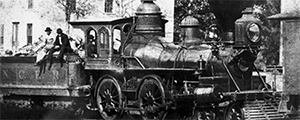
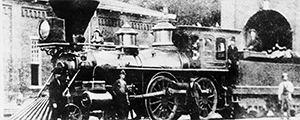
1855: The first “iron horse” arrives in Alamance County and is called the “Eighth Wonder of the World.”

1854: The Atlantic and North Carolina Railroad is chartered, with the state providing two-thirds of the capital.

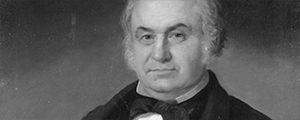
John Motley Morehead, first president of the NCRR, gives a now-famous speech referring to the railroad as the “Tree of Life” of North Carolina.

1851: Construction begins in Greensboro, with Senator Calvin Graves lifting the first shovel of dirt.

1848: NC legislature authorizes a railroad that will connect the eastern part of the state with the piedmont. The President of the Senate, Calvin Graves, makes the tie-breaking vote, ensuring that the railroad will be built. Unfortunately, the vote ends his political career because the route will not pass through his district.

1840: Two railroads open in the state—the Wilmington and Weldon and the Raleigh and Gaston.

1828: Joseph Caldwell, President of the University of North Carolina, publishes an article urging the state to finance a railroad to run horizontally across the state, opening up the western and piedmont portions for commerce.

1826: Following the lead of England, railroad construction begins in the United States.

spacer